Verification
Human oversight, validation methods, hallucination reduction, and trustworthy AI practices.
-
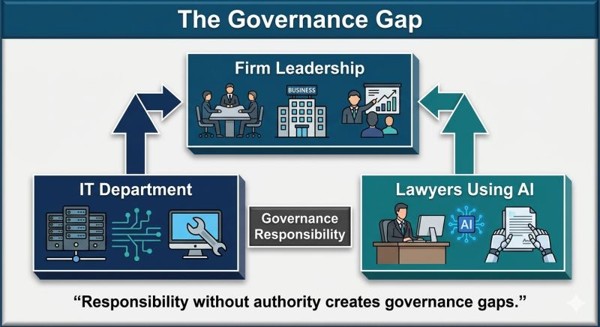
The Hidden Accountability Gap in AI Governance
Many AI governance strategies have a hidden accountability gap.IT teams manage the tools.But no one clearly owns the professional standards for how those tools are used. When AI oversight is treated solely as an IT responsibility, firms often create an unintended structural gap. Technology teams manage infrastructure, but they typically do not have authority over
-
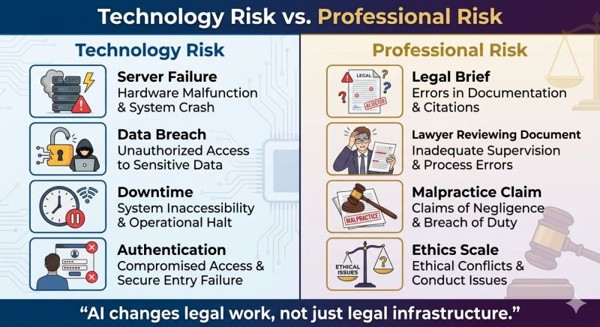
AI Creates Professional Liability Risk, Not Just Technology Risk
AI doesn’t just create technology risk for law firms.It creates professional liability risk.And that’s why insurers are starting to ask different questions about AI use. Much of the early conversation around AI in law firms focuses on technical concerns: system security, vendor integrations, and infrastructure reliability. These are important issues, but they are not the
-
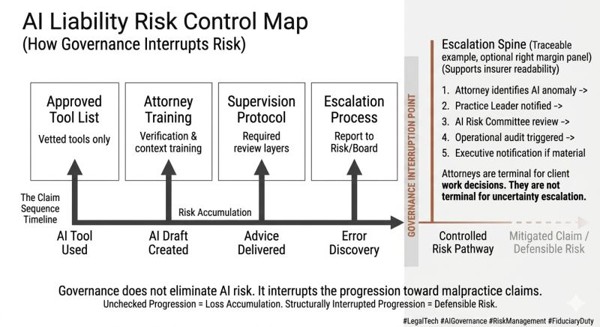
AI Governance Control Points: Stopping Risk Before It Becomes Liability
AI doesn’t fail all at once—it creeps in.Structured checkpoints stop risk before it compounds.Firms with weak escalation paths face defensibility questions. AI risk in legal practice rarely appears all at once. It accumulates across a sequence of small steps: a tool is used, a draft is created, advice is delivered, and only later is an
-
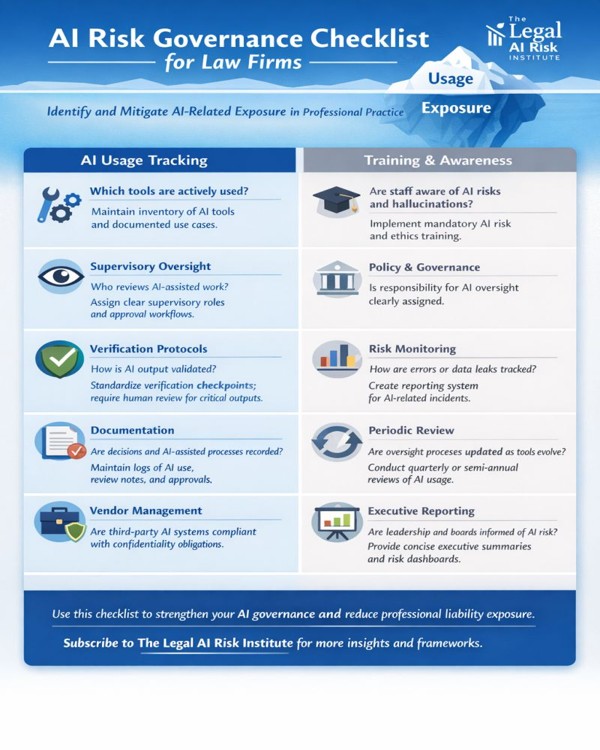
AI Governance Checklist for Law Firms: 10 Questions Every Leadership Team Should Ask
Artificial intelligence is already present in most law firms, but governance often lags behind adoption. The real risk is not simply whether AI tools are being used. It is whether firms have clear supervision, verification, documentation, and oversight around how AI influences legal work. Without those structures, the exposure created by AI can quietly grow
-
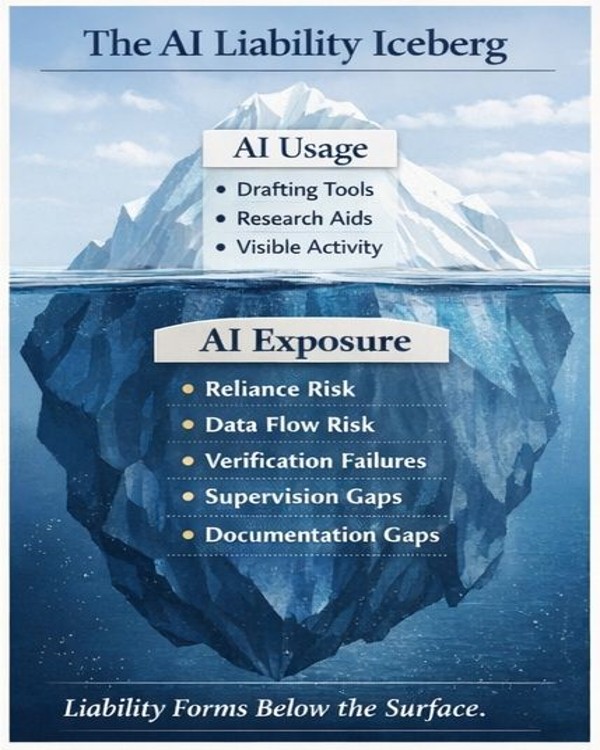
The AI Liability Iceberg: Why Risk Lies Beneath Visible AI Usage
The most visible aspects of artificial intelligence in law firms are the tools themselves. Lawyers experiment with drafting assistants, research summarizers, and analytics features embedded in familiar platforms. This visible activity represents AI usage. It is measurable, episodic, and relatively easy for leadership to observe. But the real professional liability risk rarely forms at the
-
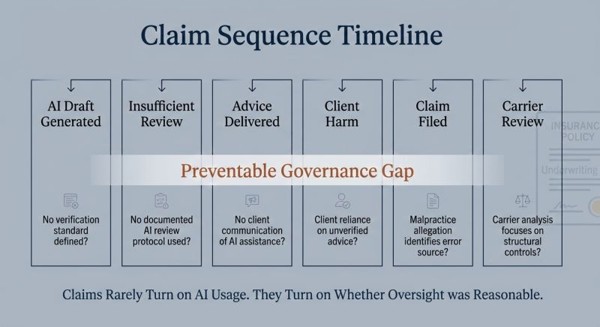
How AI Errors Become Professional Liability Claims: Understanding the Claim Sequence
Most professional liability claims do not begin with a dramatic failure. They develop through a sequence of small, ordinary events that appear reasonable at the time. The claim sequence timeline shown in this graphic illustrates how an AI-related error could move through a legal workflow before it becomes visible as a liability issue. The sequence
-
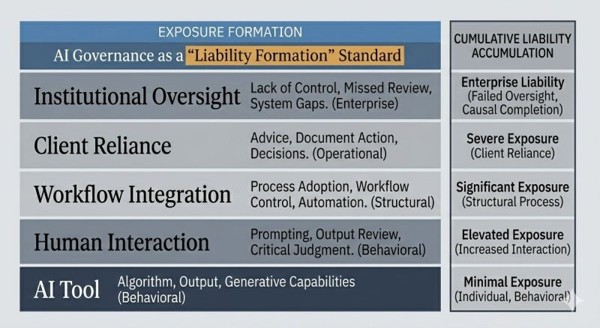
How AI Exposure Forms Inside a Law Firm: From Governance Gaps to Professional Liability
Most conversations about artificial intelligence inside law firms begin with a simple question: are lawyers using it? That question is understandable, but it only captures visible activity. The more important issue for risk and governance is where exposure actually forms. The diagram accompanying this post illustrates a common pattern: liability rarely appears at the moment
-
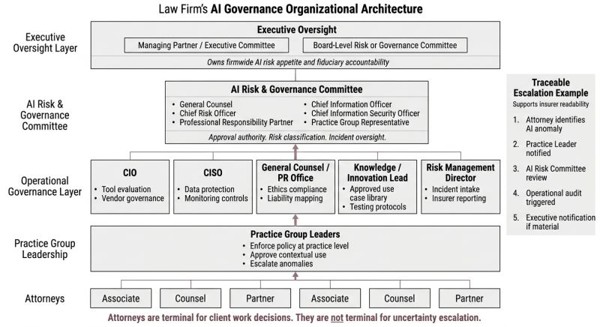
When AI Uncertainty Arises, Who Decides? Designing an AI Governance Structure for Law Firms
Law firms are beginning to experiment with artificial intelligence in uneven ways. Some have formal review processes. Others rely on informal discussions between a few interested partners and the IT department. What is often missing is a clear structure that answers a basic governance question: when uncertainty about AI arises inside the firm, where does
-
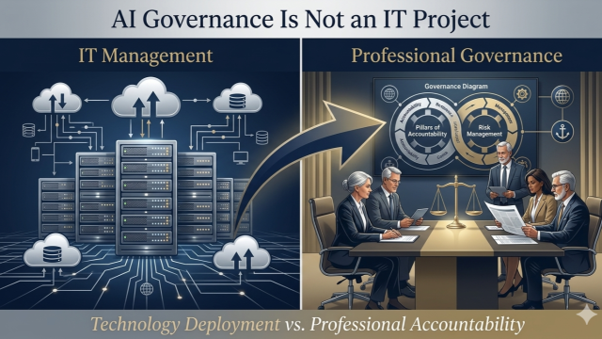
AI Governance Is Not an IT Problem: Why Leadership Must Own the Risk
In many law firms, responsibility for artificial intelligence has initially settled where new technology traditionally resides: within IT departments, innovation committees, or knowledge management teams. This allocation is understandable. AI tools arrive through software vendors, appear technical in nature, and are often introduced through demonstrations emphasizing efficiency gains. The instinct to treat AI as another
-
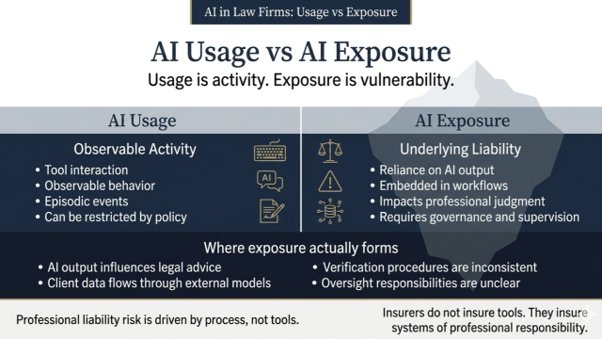
The Difference Between AI Usage and AI Exposure: What Law Firms and Insurers Need to Understand
Artificial intelligence is already embedded in most large law firms, whether leadership formally acknowledges it or not. Associates experiment with drafting tools. Vendors quietly integrate AI features into research platforms. Marketing teams deploy predictive analytics. In most firms, some level of AI activity is already present. What has not been adequately examined, particularly at the