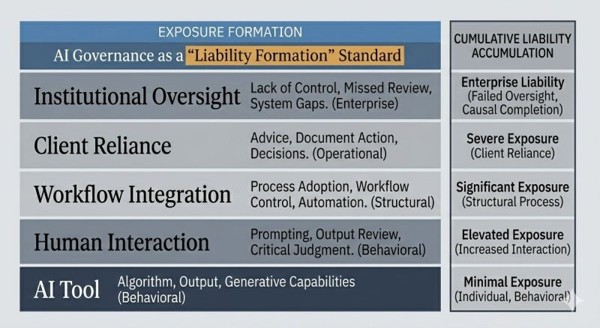
Most conversations about artificial intelligence inside law firms begin with a simple question: are lawyers using it? That question is understandable, but it only captures visible activity. The more important issue for risk and governance is where exposure actually forms. The diagram accompanying this post illustrates a common pattern: liability rarely appears at the moment a tool is opened. It develops gradually as several ordinary steps occur without sufficient structure around them.
Exposure typically begins upstream, when a firm allows a technology to be used without clearly defined policies, approved workflows, or monitoring expectations. Attorneys may rely on a tool for research, drafting, or summarization with the best of intentions. Yet the underlying model may produce subtle inaccuracies, incomplete citations, or misinterpreted facts. If the firm has not clearly defined verification expectations, the output may move forward in the work product without sufficient scrutiny.
The critical moment often arrives later, when the AI-assisted work is incorporated into a memorandum, filing, opinion, or client advice. At that stage the work product is no longer an internal experiment. It becomes part of the firm’s professional representation. If an error survives into this stage and reaches a client or court, the issue is no longer technological. It becomes a professional responsibility question about supervision, competence, and diligence.
The purpose of the exposure formation diagram is not to discourage experimentation with AI tools. It is to illustrate how small governance gaps can accumulate into meaningful risk over time. When firms map where uncertainty can enter a workflow and where verification must occur, they can allow attorneys to benefit from new tools while preserving the professional safeguards that clients and courts expect.
Questions to Consider
- Where can AI-generated errors enter our workflows?
- Where are verification checkpoints currently required?
- Are there stages where AI-assisted work can move forward without review?
- Have we identified where AI output becomes professional advice?
- Can we demonstrate that safeguards exist before client delivery?
Next Steps for Law Firms
1. Map AI-Assisted Workflows
Identify where attorneys currently use AI for research, drafting, summarization, analysis, or client communications.
2. Identify Exposure Formation Points
Determine where AI-generated outputs enter work products, client advice, filings, contracts, or legal opinions.
3. Define Verification Requirements
Establish clear expectations regarding fact-checking, citation validation, legal research confirmation, and supervisory review.
4. Create Verification Checkpoints
Embed verification requirements into existing workflows rather than relying on individual discretion.
5. Document Review Expectations
Specify who is responsible for reviewing AI-assisted work and what constitutes adequate review.
6. Test Existing Controls
Review recent AI-assisted work products to identify weaknesses in verification and supervision processes.
7. Monitor Recurring Failure Patterns
Track common errors, near misses, and workflow weaknesses to improve governance over time.
Next Steps for Risk Managers and Professional Liability Carriers
1. Evaluate Verification Controls
Assess whether firms have documented procedures for validating AI-assisted work.
2. Review Workflow Integration Risks
Determine where AI outputs are incorporated into client-facing work products.
3. Assess Governance Maturity
Evaluate whether verification requirements are formalized, monitored, and consistently applied.
4. Examine Supervisory Structures
Determine how attorneys are expected to review AI-generated research, drafting, and analysis.
5. Incorporate Verification Into Underwriting Reviews
Move beyond AI usage questions and assess how firms prevent AI-generated errors from reaching clients.
6. Monitor Emerging Claims Trends
Track incidents involving hallucinations, unsupported citations, factual inaccuracies, and workflow failures.
Related Topics
- AI Verification Frameworks
- Human Oversight of AI Outputs
- AI Governance Controls
- Professional Responsibility and AI
- AI Hallucination Risk
- Defensible AI Usage
- Legal Malpractice and Artificial Intelligence
- Workflow-Based AI Risk Assessment
- AI Quality Assurance
- AI-Assisted Legal Research
- Supervisory Responsibilities in AI Usage
- Risk-Based AI Governance
- AI Error Prevention
- AI Incident Management
- Verification Governance