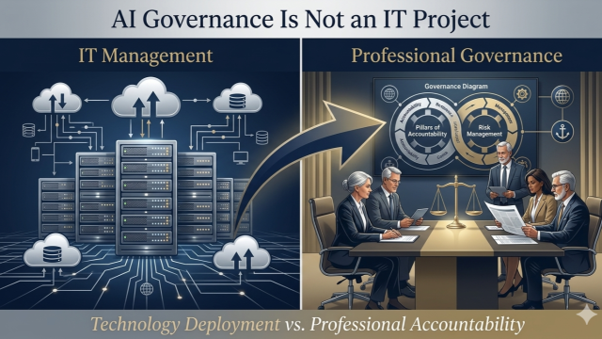
In many law firms, responsibility for artificial intelligence has initially settled where new technology traditionally resides: within IT departments, innovation committees, or knowledge management teams. This allocation is understandable. AI tools arrive through software vendors, appear technical in nature, and are often introduced through demonstrations emphasizing efficiency gains. The instinct to treat AI as another technology deployment follows patterns firms have relied upon for decades.
Yet framing AI governance as a technology initiative risks misunderstanding the nature of the exposure now emerging. The central issues raised by AI adoption do not primarily concern system uptime, software configuration, or user access permissions. They concern professional judgment, competence, supervision, documentation, and accountability, all of which sit squarely within the domain of firm leadership rather than technical administration.
The distinction matters because governance failures rarely arise from malfunctioning tools. They arise when organizational responsibility fails to keep pace with operational change.
The Historical Pattern: Technology Arrives Before Governance
Law firms have encountered similar moments before. Electronic discovery, cloud storage, and cybersecurity each entered practice environments as technical developments. In their early stages, firms frequently delegated oversight to technical specialists while partners assumed that professional norms would adapt organically. Only later, often after courts or regulators intervened, did leadership recognize that the risks implicated fiduciary duties and supervisory obligations extending beyond IT.
AI presents a comparable transition, though its effects reach more directly into the substance of legal work. Unlike earlier technologies that primarily changed how information was stored or transmitted, generative AI can influence how analysis is formed and what advice is expressed. That shift places AI closer to the core of professional responsibility than many prior technological changes.
When AI output informs legal reasoning, even indirectly, governance can no longer remain a peripheral administrative concern.
Why the IT Model Breaks Down
IT departments are well equipped to manage infrastructure risks. They oversee access controls, data security configurations, and vendor integrations. Those functions remain essential, but they do not address the questions most likely to arise in a malpractice inquiry.
Consider the issues that surface when an error occurs involving AI-assisted work:
Who determined acceptable uses of the technology? What supervisory expectations applied to AI-assisted drafting? How were attorneys trained to evaluate output reliability? What disclosures were considered appropriate for clients? How did leadership monitor evolving risks?
None of these questions are technical in nature. They concern professional standards and organizational decision-making. Delegating them entirely to IT places responsibility in a function that lacks authority over attorney conduct and practice management.
The result is not negligence in any intentional sense. It is misalignment between responsibility and authority, a condition that repeatedly appears in post-incident analysis across many areas of professional liability.
Governance as a Leadership Function
Effective AI governance resembles conflicts management or quality control more than software administration. It requires clear ownership at the executive level, supported by cross-functional input but anchored in leadership accountability.
Managing partners and executive committees should expect to address several foundational questions:
- What categories of AI use align with the firm’s risk tolerance?
- Where must human verification be mandatory?
- How should responsibility for AI-assisted work be supervised and documented?
- How will the firm evaluate vendor representations concerning confidentiality and data use?
- What reporting mechanisms ensure leadership visibility into emerging issues?
These are governance decisions because they define how professional judgment is exercised within the institution. Technology teams can inform them, but they cannot legitimately own them.
The Subtle Risk of Informal Adoption
One of the complicating features of AI is that adoption does not always occur through formal rollout. Associates experiment independently. Practice groups adopt tools unevenly. Vendors introduce AI capabilities through routine software updates. Over time, usage patterns evolve organically without a corresponding evolution in oversight.
Leadership may therefore believe AI remains limited in scope while reliance quietly expands at the working level of the firm. This gap between perception and practice creates difficulty when firms later attempt to reconstruct decision-making processes.
In malpractice matters, reconstruction is often the most challenging phase of defense. Questions arise about who knew what or should have know, when policies were implemented, and whether expectations were consistently communicated. Informal adoption rarely leaves a clean evidentiary trail.
Governance, properly implemented, reduces ambiguity before problems occur rather than attempting to resolve it afterward.
AI Governance and Professional Culture
Law firms operate through professional autonomy balanced by supervisory responsibility. Partners rightly expect lawyers to exercise independent judgment. Governance frameworks must therefore avoid appearing as technological restriction mechanisms that undermine professional discretion.
The more effective approach is to articulate principles rather than prohibitions. Attorneys should understand not only what is permitted, but why verification, documentation, and supervision remain essential even when tools appear reliable. When governance is framed as supporting defensible practice rather than limiting innovation, adoption tends to be more consistent and less adversarial.
Culture plays a significant role here. Lawyers take cues from leadership attention. When executive committees treat AI governance as a standing agenda item rather than an occasional discussion, the firm signals that AI risk belongs alongside conflicts management, ethics compliance, and client confidentiality as a core institutional concern.
The Role of Documentation
Documentation often appears mundane until it becomes decisive. In disputes involving professional judgment, written policies, training records, and oversight structures help demonstrate that the firm exercised reasonable care in anticipating foreseeable risks.
AI introduces new questions about reliance and verification that courts and regulators are only beginning to consider. Firms cannot yet rely on settled precedent to define best practices. In that environment, documented governance efforts may become one of the most persuasive indicators of diligence.
Documentation also serves an internal purpose. It clarifies expectations, reduces inconsistent practices across offices and practice groups, and provides a basis for periodic reassessment as technology evolves.
Moving From Innovation to Oversight
Many firms initially approach AI through innovation initiatives focused on efficiency and competitiveness. That phase is both natural and necessary. Over time, however, leadership attention must expand beyond capability toward oversight.
This transition does not require abandoning experimentation. It requires recognizing that experimentation itself carries institutional implications. Governance ensures that experimentation occurs within boundaries that protect both clients and the firm.
Executive leadership is uniquely positioned to balance these considerations because it can align risk tolerance, client expectations, insurer concerns, and professional obligations within a single framework. No other function within the firm has comparable visibility across those dimensions.
A Leadership Question, Not a Technical One
The most important question for law firm leadership is therefore not whether AI tools are sufficiently advanced or sufficiently secure. It is whether the firm’s governance structures have evolved to reflect how legal work is now being performed.
When AI is treated solely as an IT project, governance gaps tend to persist unnoticed. When it is treated as an enterprise risk issue, oversight naturally migrates to the executive level, where decisions about supervision, accountability, and professional standards properly reside.
Law firms have navigated technological change successfully many times before. The firms that did so most effectively were those that recognized early that technology alters not only tools, but expectations surrounding professional responsibility.
AI appears poised to follow that same trajectory. Leadership engagement at this stage may determine whether the transition is experienced as orderly adaptation or reactive correction after avoidable difficulty.
Questions to Consider
- Is AI governance currently owned by the right people?
- What governance decisions are being made by technology teams that should involve leadership?
- Can executive leadership articulate the firm’s AI risk tolerance?
- Who would answer questions about supervision and accountability during litigation?
- Have governance responsibilities evolved alongside AI adoption?
Next Steps for Law Firm Leadership
1. Reevaluate Governance Ownership
Determine whether AI governance currently resides primarily within IT, innovation, or knowledge management functions and assess whether that ownership model aligns with the firm’s risk profile.
2. Establish Executive Accountability
Assign clear responsibility for AI governance at the executive committee or managing partner level.
3. Create Cross-Functional Governance Structures
Ensure governance includes leadership from risk management, professional responsibility, technology, security, and practice groups.
4. Define Firm-Wide Risk Tolerance
Establish acceptable uses, prohibited uses, verification requirements, and escalation thresholds.
5. Increase Leadership Visibility
Implement recurring reporting on AI adoption, incidents, policy exceptions, vendor risks, and governance metrics.
6. Formalize Documentation Standards
Ensure policies, training records, oversight activities, and governance decisions are documented and retained.
7. Treat AI as an Enterprise Risk Category
Integrate AI governance into existing risk, compliance, ethics, and professional responsibility frameworks.
Next Steps for Boards and Executive Committees
1. Place AI Governance on the Standing Agenda
Review AI governance alongside cybersecurity, conflicts management, and professional responsibility issues.
2. Clarify Oversight Responsibilities
Define which committee or executive function has ultimate accountability for AI governance.
3. Require Governance Reporting
Receive periodic updates on adoption, incidents, controls, training, and emerging risks.
4. Review Governance Maturity
Assess whether governance capabilities are evolving at the same pace as AI adoption.
5. Evaluate Documentation Readiness
Determine whether the firm could demonstrate reasonable oversight if challenged by regulators, clients, insurers, or courts.
6. Monitor Emerging Liability Trends
Stay informed about sanctions, regulatory guidance, insurer expectations, and evolving professional standards.
Next Steps for Professional Liability Carriers
1. Assess Leadership Engagement
Determine whether AI governance is treated as an executive responsibility or a technology initiative.
2. Evaluate Accountability Structures
Review governance ownership, committee structures, and reporting relationships.
3. Examine Documentation Practices
Assess whether governance activities are formally documented and consistently maintained.
4. Review Verification and Supervision Controls
Evaluate how leadership ensures AI-assisted work receives appropriate review and oversight.
5. Differentiate Firms by Governance Maturity
Use executive engagement as a leading indicator of risk quality.
Related Topics
- Board Oversight of Artificial Intelligence
- AI Governance Frameworks
- Executive Accountability for AI
- Enterprise Risk Management
- Professional Responsibility and AI
- AI Verification Controls
- Defensible AI Governance
- AI Governance Committees
- Law Firm Risk Management
- AI Policy Development
- Human Oversight of AI
- Technology Governance
- AI Governance Maturity Models
- Professional Liability and AI
- Fiduciary Responsibilities in the AI Era