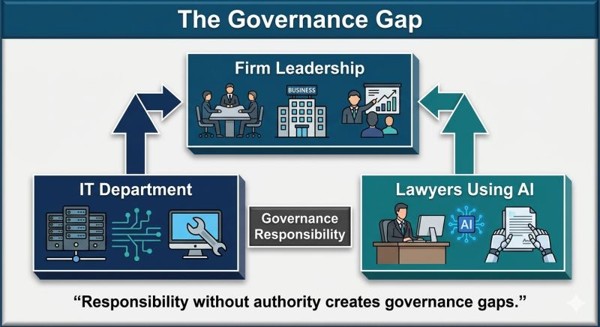
Many AI governance strategies have a hidden accountability gap.
IT teams manage the tools.
But no one clearly owns the professional standards for how those tools are used.
When AI oversight is treated solely as an IT responsibility, firms often create an unintended structural gap. Technology teams manage infrastructure, but they typically do not have authority over attorney conduct, supervision standards, or professional accountability.
Effective AI governance requires alignment between responsibility and authority. Leadership must define how AI is used, how work is supervised, and how risk is monitored across the firm. Without that alignment, oversight can become fragmented just when clarity is most important.
Questions to Consider
- Does responsibility for AI governance align with authority?
- Who owns professional standards for AI-assisted work?
- Could multiple leaders identify the same accountable party?
- Are there governance activities that no one clearly owns?
- How would accountability be demonstrated under scrutiny?
Next Steps for Law Firms
1. Map AI Governance Responsibilities
Identify who currently owns technology management, policy development, training, supervision, vendor review, and incident management.
2. Identify Accountability Gaps
Look for areas where responsibility exists without corresponding authority to enforce standards.
3. Assign Executive Ownership
Ensure AI governance has a clearly designated executive sponsor or governing body.
4. Align Authority With Responsibility
Provide governance owners with sufficient authority to establish policies, require training, and enforce oversight expectations.
5. Clarify Supervisory Expectations
Define how attorneys, practice leaders, and firm leadership share responsibility for AI-assisted work.
6. Establish Escalation Mechanisms
Create clear pathways for reporting governance concerns, incidents, and unusual AI behavior.
7. Document Governance Roles
Maintain formal records defining governance responsibilities and decision-making authority.
Next Steps for Executive Leadership
1. Ask a Simple Question
“Who can credibly testify that the firm exercises structured oversight of AI?”
If the answer is unclear, a governance gap likely exists.
2. Review Governance Ownership
Determine whether AI oversight is concentrated in technology functions without sufficient leadership involvement.
3. Define Accountability Structures
Clarify ultimate ownership for policy decisions, supervision standards, verification requirements, and governance reporting.
4. Establish Cross-Functional Governance
Ensure leadership, risk, technology, professional responsibility, and practice leadership participate in oversight.
5. Monitor Governance Effectiveness
Periodically evaluate whether responsibilities remain aligned with authority.
Next Steps for Professional Liability Carriers
1. Assess Governance Accountability
Determine whether firms have identified a clear owner for AI governance.
2. Review Organizational Alignment
Evaluate whether governance authority matches governance responsibility.
3. Examine Leadership Involvement
Assess executive participation in governance decisions and oversight.
4. Identify Fragmentation Risks
Look for governance structures where responsibilities are distributed but accountability is unclear.
5. Consider Accountability Maturity in Underwriting
Clear ownership often correlates with stronger governance execution.
Related Topics
- Executive Accountability for AI
- Board Oversight of Artificial Intelligence
- AI Governance Frameworks
- AI Governance Committees
- Governance Operating Models
- Professional Responsibility and AI
- Human Oversight of AI
- Defensible AI Governance
- AI Verification Controls
- Enterprise Risk Management
- AI Escalation Frameworks
- Law Firm Governance
- Risk Ownership Models
- Governance Maturity Models
- Professional Liability and AI