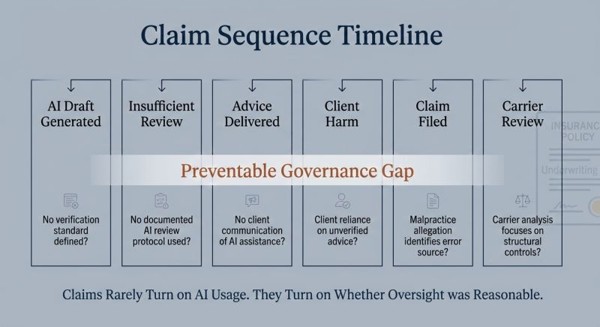
Most professional liability claims do not begin with a dramatic failure. They develop through a sequence of small, ordinary events that appear reasonable at the time. The claim sequence timeline shown in this graphic illustrates how an AI-related error could move through a legal workflow before it becomes visible as a liability issue.
The sequence often begins with the generation of AI-assisted work product. A lawyer may ask a system to summarize research, draft language, or organize a body of information. In many cases the output appears plausible and helpful. The risk is not the use of the tool itself, but the possibility that subtle inaccuracies or fabricated elements enter the draft unnoticed. At this early stage, the problem is still easily contained if verification procedures are consistently applied.
The next stage is reliance. The AI-assisted material is incorporated into legal analysis, advice, or filings. Once the content is integrated into client work, the technology becomes invisible. What remains is the lawyer’s professional judgment and the representation being delivered to the client. If an error survives this transition, the exposure begins to shift from a technical issue to a question of professional responsibility and supervision.
Only later, often weeks or months after the original work was produced, does the final stage appear. A client, court, or opposing counsel identifies the error and a dispute emerges about whether reasonable diligence and oversight were exercised. By the time the claim sequence reaches this point, the original technical question has disappeared. What remains is a familiar malpractice analysis: whether the firm had the governance structures, review practices, and escalation pathways necessary to prevent the error from reaching the client in the first place.
Questions to Consider
- At what stage would our firm likely detect an AI-related error?
- Are verification procedures strong enough to prevent reliance on inaccurate output?
- How would we demonstrate supervision if a claim emerged months later?
- What documentation would exist to support our defense?
- Which controls interrupt risk before it reaches a client or court?
Next Steps for Law Firms
1. Map the AI Claim Sequence Within Your Firm
Identify where AI-generated outputs enter workflows and where reliance decisions occur.
2. Define Verification Requirements at Each Stage
Document review expectations before AI-assisted content can advance into client-facing work.
3. Create Formal Escalation Procedures
Establish clear pathways for attorneys to report questionable outputs, unusual results, or uncertainty.
4. Identify Reliance Decision Points
Determine where attorneys transition from reviewing AI output to incorporating it into legal advice, filings, or work product.
5. Strengthen Supervisory Controls
Ensure that AI-assisted work receives appropriate oversight before client delivery.
6. Conduct Near-Miss Reviews
Analyze incidents where errors were caught before reaching clients to improve controls and training.
7. Document Governance Activities
Maintain records demonstrating policy compliance, training, review procedures, and oversight practices.
Next Steps for Professional Liability Carriers
1. Assess Verification Maturity
Evaluate whether firms have documented procedures for validating AI-generated work.
2. Review Reliance Controls
Understand how firms prevent unverified AI outputs from becoming client-facing legal advice.
3. Evaluate Escalation Mechanisms
Determine whether attorneys have structured processes for addressing uncertainty and anomalies.
4. Incorporate Governance Reviews Into Underwriting
Assess oversight structures, training programs, and review protocols rather than focusing solely on tool usage.
5. Analyze Claim Formation Risks
Consider where AI-related errors are most likely to survive existing controls and become claims.
6. Encourage Preventative Governance Measures
Reward firms that demonstrate mature verification practices and documented oversight structures.
Related Topics
- AI Verification Frameworks
- Professional Liability Risk Management
- AI Governance Controls
- AI Error Prevention
- Human Oversight of AI Outputs
- Legal Malpractice and Artificial Intelligence
- Defensible AI Governance
- AI Escalation Procedures
- AI Risk Assessment
- Supervisory Responsibilities in AI Usage
- AI Incident Reporting
- Workflow-Based Risk Analysis
- Claims Prevention Strategies
- Verification Governance
- AI Assurance Programs