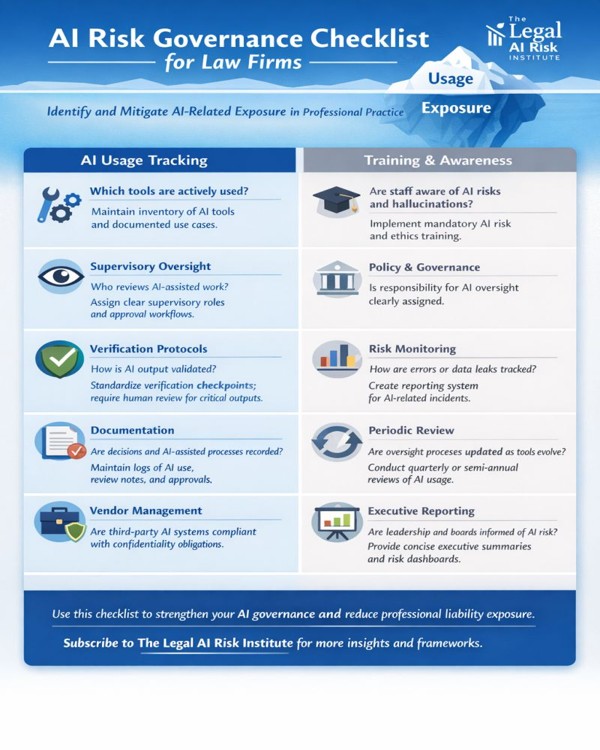
Artificial intelligence is already present in most law firms, but governance often lags behind adoption. The real risk is not simply whether AI tools are being used. It is whether firms have clear supervision, verification, documentation, and oversight around how AI influences legal work. Without those structures, the exposure created by AI can quietly grow even when usage appears limited.
This governance checklist highlights several areas law firm leadership and risk professionals should examine: tracking which tools are in use, assigning supervisory responsibility for AI-assisted work, standardizing verification protocols, managing vendor risk, and ensuring executive visibility into emerging issues. AI does not eliminate professional responsibility. If anything, it makes structured oversight more important.
If you are involved in law firm leadership, risk management, or professional liability underwriting, I regularly share practical frameworks on how AI is reshaping governance and liability exposure in legal practice. Follow for additional insights and guidance.
Questions to Consider
- Have we inventoried all AI tools currently being used?
- Are governance responsibilities formally assigned?
- Do attorneys understand verification expectations?
- Is AI training mandatory and documented?
- Would an external reviewer conclude that our governance program is operational or merely aspirational?
Next Steps for Law Firms
1. Complete an AI Governance Assessment
Evaluate your current state against the checklist categories and identify governance gaps.
2. Inventory AI Usage Across the Organization
Document approved, unofficial, and vendor-integrated AI capabilities currently in use.
3. Assign Accountability
Clearly define who owns AI governance, oversight, policy management, and escalation procedures.
4. Formalize Verification Standards
Create documented review requirements for AI-assisted research, drafting, analysis, and client communications.
5. Review Vendor Risk Controls
Assess contracts, data retention practices, confidentiality protections, and AI-related terms.
6. Establish Executive Reporting
Create recurring reporting mechanisms for AI adoption, incidents, policy exceptions, and emerging risks.
7. Develop a Governance Roadmap
Prioritize remediation activities and establish timelines for strengthening controls.
Next Steps for Professional Liability Carriers
1. Incorporate Governance Assessments Into Underwriting
Use governance maturity as a risk differentiation factor.
2. Evaluate Verification Controls
Assess how firms validate AI-assisted work before client reliance occurs.
3. Review Oversight Structures
Understand who owns AI governance and how accountability is maintained.
4. Examine Vendor Governance Practices
Assess how firms manage AI-related third-party risks.
5. Encourage Governance Maturity
Provide guidance, incentives, or preferred treatment for firms demonstrating strong governance controls.
6. Monitor Governance Trends Across the Portfolio
Identify common weaknesses and emerging patterns of exposure.
Related Topics
- AI Governance Frameworks
- Law Firm AI Governance
- AI Governance Committees
- AI Verification Controls
- AI Risk Management
- Vendor Risk Management
- Human Oversight of AI
- AI Policy Development
- Defensible AI Governance
- AI Readiness Assessments
- Professional Liability and AI
- Board Oversight of AI
- AI Governance Maturity Models
- Verification Governance
- Enterprise Risk Management