Law firms are beginning to experiment with artificial intelligence in uneven ways. Some have formal review processes. Others rely on informal discussions between a few interested partners and the IT department. What is often missing is a clear structure that answers a basic governance question: when uncertainty about AI arises inside the firm, where does that uncertainty go?
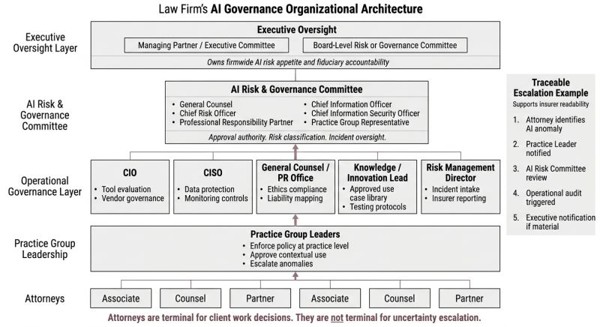
The architecture shown in this diagram illustrates one way a firm can answer that question. At the top sits executive oversight, typically the managing partner or executive committee together with a board-level risk or governance function. Beneath that is a cross-functional AI governance committee that includes risk leadership, information security, technology leadership, professional responsibility counsel, and a representative from the practicing side of the firm. This committee acts as the control center for evaluating tools, defining acceptable uses, and reviewing incidents or anomalies that emerge during real work.
Operational leaders support this governance layer. Technology leaders evaluate systems and vendors. Security professionals monitor data protection and system behavior. Professional responsibility and risk management functions consider ethics obligations and malpractice exposure. Practice group leaders translate the firm’s governance policies into the daily workflows of lawyers, ensuring that experimentation with new tools occurs within defined boundaries rather than through informal or isolated efforts.
At the bottom of the structure are the attorneys themselves. They remain the final decision-makers for client work, but they should never be the final stop for uncertainty about AI behavior. When an anomaly appears, the firm should have a clear path for escalation through practice leadership and governance channels. Not every firm will need this exact structure, particularly smaller firms. But every firm experimenting with AI should be able to answer a simple question: when the technology behaves unpredictably, who is responsible for understanding it and deciding what happens next?
Questions to Consider
- When AI behaves unexpectedly, who is responsible for evaluating the issue?
- Do attorneys know where AI-related concerns should be escalated?
- Is accountability for AI governance clearly assigned?
- Does our governance structure include legal, risk, security, and technology perspectives?
- Would different leaders provide the same answer if asked who owns AI governance?
Next Steps for Law Firms
1. Identify Current AI Decision Makers
Determine who currently approves tools, addresses incidents, and interprets AI-related risks.
2. Define Escalation Paths
Create documented procedures describing where attorneys should elevate concerns regarding AI-generated outputs, unexpected behavior, or policy violations.
3. Establish an AI Governance Committee
Create a cross-functional governance body that includes technology, security, risk, ethics, and practice leadership.
4. Clarify Roles and Responsibilities
Document ownership for policy development, vendor review, incident management, training, and oversight.
5. Integrate Governance Into Practice Groups
Ensure practice leaders understand how firm-wide AI policies apply to client-facing legal work.
6. Create AI Incident Reporting Procedures
Develop mechanisms for reporting, investigating, and resolving AI-related anomalies or governance concerns.
7. Test Governance Through Scenarios
Conduct tabletop exercises involving hallucinations, confidentiality concerns, vendor failures, or inappropriate AI usage.
Next Steps for Executive Leadership and Boards
1. Assign Formal Oversight Responsibility
Determine which committee, executive, or governance function is accountable for AI oversight.
2. Review Existing Governance Gaps
Assess whether AI oversight currently exists as a structured function or as an informal collection of conversations.
3. Require Governance Reporting
Request periodic reporting on AI adoption, incidents, policy compliance, training completion, and emerging risks.
4. Evaluate Governance Maturity
Determine whether the firm’s governance structure is proportional to its level of AI usage and exposure.
5. Ensure Cross-Functional Participation
Verify that risk, ethics, security, technology, and practice leadership are represented in governance discussions.
6. Review Escalation Effectiveness
Confirm that attorneys know where uncertainty should be reported and how governance decisions are communicated back to the firm.
Related Topics
- AI Governance Committees
- Law Firm AI Governance
- AI Escalation Frameworks
- AI Accountability Models
- Professional Responsibility and AI
- AI Risk Management
- AI Incident Response
- Defensible AI Governance
- Human Oversight of Artificial Intelligence
- AI Policy Implementation
- Board Oversight of AI
- AI Verification and Escalation
- AI Governance Operating Models
- Law Firm Risk Management
- Organizational Design for AI Governance