AI Governance
Governance frameworks, risk management, policy design, regulatory readiness, and responsible AI adoption.
-
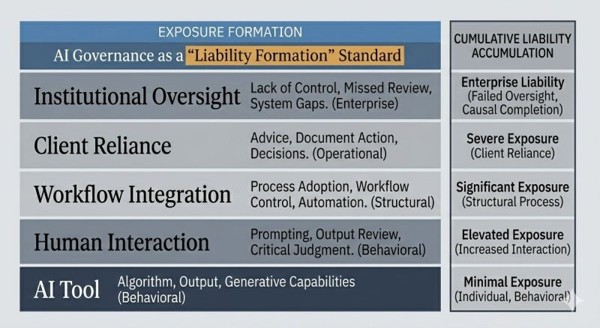
How AI Exposure Forms Inside a Law Firm: From Governance Gaps to Professional Liability
Most conversations about artificial intelligence inside law firms begin with a simple question: are lawyers using it? That question is understandable, but it only captures visible activity. The more important issue for risk and governance is where exposure actually forms. The diagram accompanying this post illustrates a common pattern: liability rarely appears at the moment
-
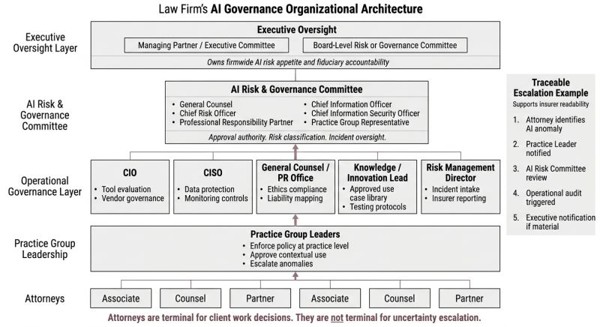
When AI Uncertainty Arises, Who Decides? Designing an AI Governance Structure for Law Firms
Law firms are beginning to experiment with artificial intelligence in uneven ways. Some have formal review processes. Others rely on informal discussions between a few interested partners and the IT department. What is often missing is a clear structure that answers a basic governance question: when uncertainty about AI arises inside the firm, where does
-
AI is Now an Enterprise Risk and Performance Multiplier
AI is neither optional nor experimental.It is infrastructure. Our responsibility is to govern it. AI Introduces Non-Linear Risk•Speed amplifies errors•Individual actions scale instantly•Liability attaches to the organization Without Governance, AI Usage Is Invisible•Shadow AI usage already exists•Data leakage risk is real•Discovery and audit exposure is increasing Enterprise AI Control Framework•Mandatory training•Approved tool boundaries•Escalation / decision
-
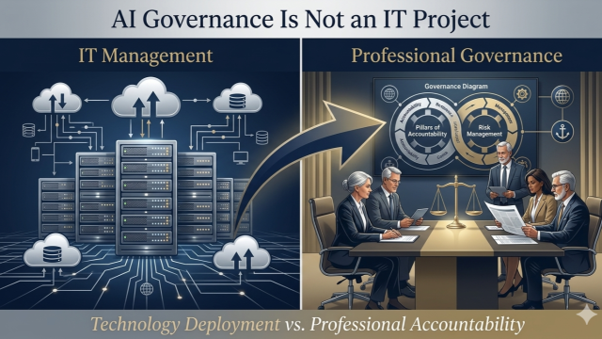
AI Governance Is Not an IT Problem: Why Leadership Must Own the Risk
In many law firms, responsibility for artificial intelligence has initially settled where new technology traditionally resides: within IT departments, innovation committees, or knowledge management teams. This allocation is understandable. AI tools arrive through software vendors, appear technical in nature, and are often introduced through demonstrations emphasizing efficiency gains. The instinct to treat AI as another
-
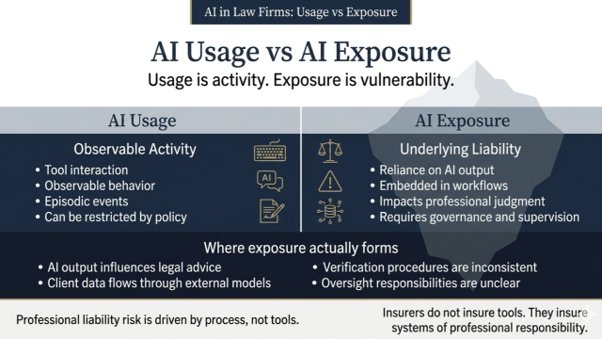
The Difference Between AI Usage and AI Exposure: What Law Firms and Insurers Need to Understand
Artificial intelligence is already embedded in most large law firms, whether leadership formally acknowledges it or not. Associates experiment with drafting tools. Vendors quietly integrate AI features into research platforms. Marketing teams deploy predictive analytics. In most firms, some level of AI activity is already present. What has not been adequately examined, particularly at the
-
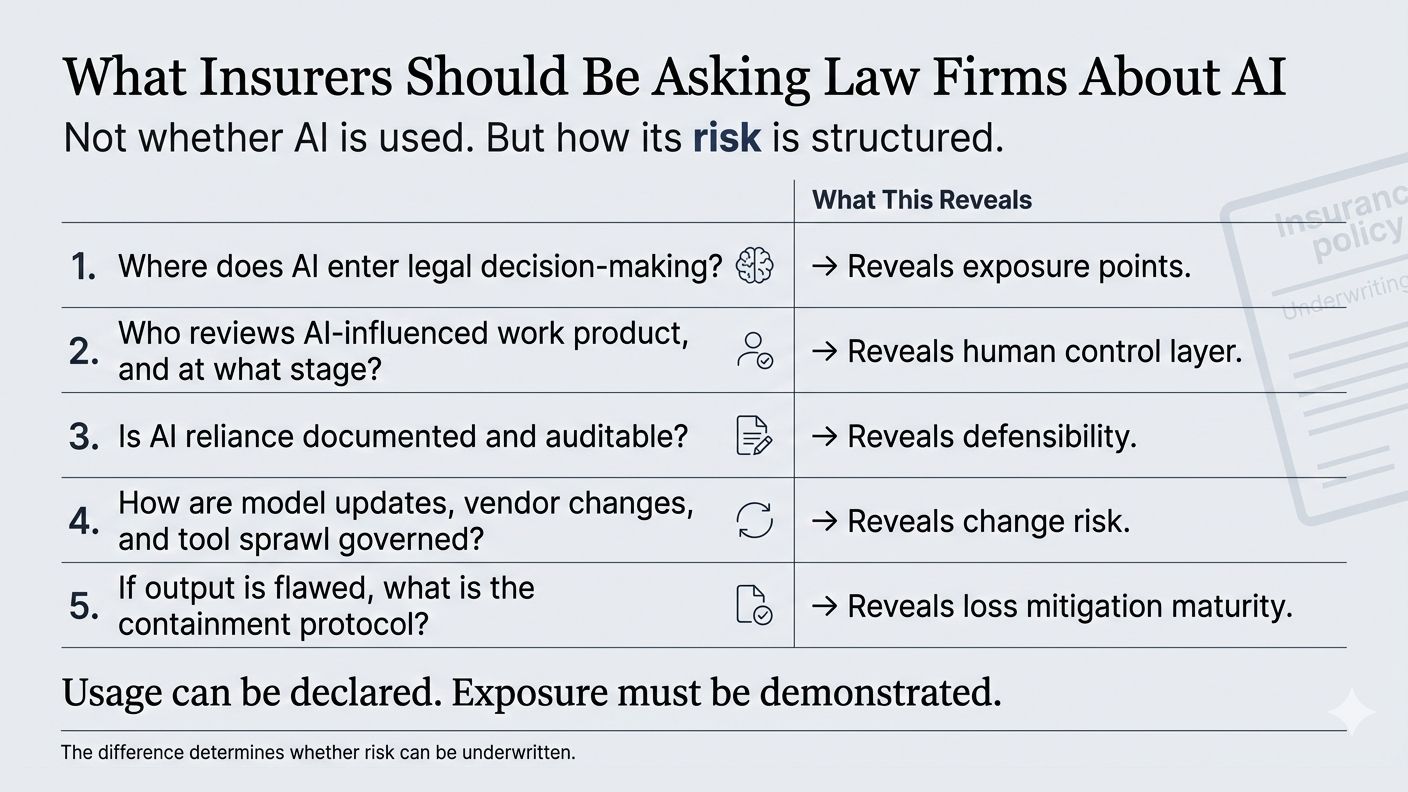
What Insurers Should Be Asking Law Firms About AI
Over the past three decades in the professional liability field, we can observe a recurring underwriting pattern whenever a new operational risk enters the legal marketplace. In the early phase, firms describe the risk in terms of experimentation and efficiency. Carriers initially treat it as a technological development rather than a structural shift. Only later,