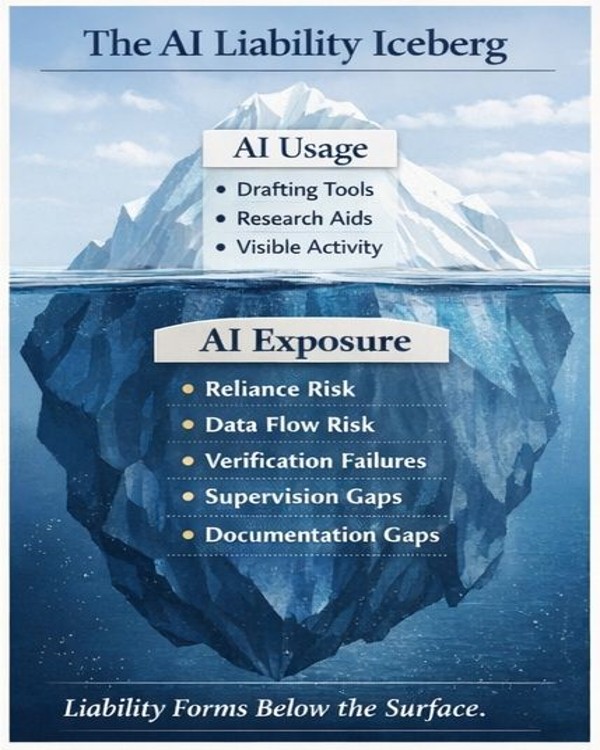
The most visible aspects of artificial intelligence in law firms are the tools themselves. Lawyers experiment with drafting assistants, research summarizers, and analytics features embedded in familiar platforms. This visible activity represents AI usage. It is measurable, episodic, and relatively easy for leadership to observe. But the real professional liability risk rarely forms at the point where a tool is used. It develops beneath the surface, where AI output begins to influence legal judgment, where client data moves through third-party systems, and where verification or supervisory practices are not clearly defined.
The “AI Liability Iceberg” illustrates this structural distinction. Above the surface sits the visible layer of experimentation and tool interaction. Below the surface lies AI exposure: reliance risk, data flow risk, verification gaps, and documentation weaknesses that may only become apparent after a dispute arises. As with earlier technology-driven risk categories, insurers and plaintiffs’ counsel ultimately focus on process rather than tools. The firms best positioned for the coming scrutiny will be those that treat AI governance as part of their professional responsibility framework rather than simply another productivity technology.
If this distinction between AI usage and AI exposure is relevant to the challenges your organization is navigating, I regularly share practical frameworks and observations on how AI is actually reshaping professional risk inside law firms. Follow along for ongoing insights on governance, liability exposure, and what insurers and firm leadership should be paying attention to as AI adoption continues to evolve.
Questions to Consider
- Are we measuring AI usage or AI exposure?
- What risks exist beneath visible experimentation?
- Could hidden data flows create confidentiality concerns?
- How consistently are AI-assisted outputs verified?
- Would leadership be surprised by the firm’s actual AI exposure profile?
Next Steps for Law Firms
1. Distinguish AI Usage From AI Exposure
Move beyond tracking who uses AI and identify where AI outputs influence legal judgment, client communications, and work product.
2. Map Hidden Risk Areas
Document where reliance risk, data flow risk, verification gaps, and documentation weaknesses may exist.
3. Evaluate Current Verification Controls
Assess whether attorneys have clear expectations regarding review, validation, and supervision of AI-assisted work.
4. Review Third-Party Data Flows
Understand how client information moves through AI-enabled vendors, platforms, and integrated systems.
5. Strengthen Governance Documentation
Ensure policies, training records, oversight activities, and review procedures can be demonstrated if challenged.
6. Monitor Exposure Indicators
Track governance metrics rather than focusing exclusively on AI adoption metrics.
Next Steps for Professional Liability Carriers
1. Move Beyond AI Usage Questions
Assess how firms govern AI rather than simply whether they use it.
2. Evaluate Exposure Formation Mechanisms
Review verification controls, supervision practices, data governance, and escalation procedures.
3. Assess Governance Maturity
Determine whether firms have formal oversight structures capable of managing AI-related risk.
4. Review Vendor and Data Risks
Examine how firms evaluate AI-enabled third-party services and contractual protections.
5. Incorporate Governance Indicators Into Underwriting
Consider governance controls as leading indicators of risk quality.
6. Monitor Emerging Exposure Trends
Track patterns related to verification failures, data handling concerns, and supervisory weaknesses.
Related Topics
- AI Governance Frameworks
- AI Verification Controls
- AI Risk Management
- Professional Liability and Artificial Intelligence
- Law Firm AI Governance
- Defensible AI Governance
- AI Exposure Formation
- AI Liability Risk
- Human Oversight of AI
- AI Vendor Risk Management
- AI Policy Development
- Professional Responsibility and AI
- AI Audit Readiness
- Enterprise Risk Management
- Verification Governance
Internal Linking Opportunities
This article should link strongly to:
- How AI Exposure Forms Inside a Law Firm
- How AI Errors Become Professional Liability Claims
- When AI Uncertainty Arises, Who Decides?
- AI Is Now an Enterprise Risk and Performance Multiplier
- How Underwriters Should Evaluate Law Firm AI Governance
- AI Verification: The Missing Control in Most AI Programs
- Building Defensible AI Governance Programs
- The Role of Human Oversight in AI Risk Management
- Mapping AI Risk Across Legal Workflows
- AI Governance Metrics Every Leadership Team Should Monitor