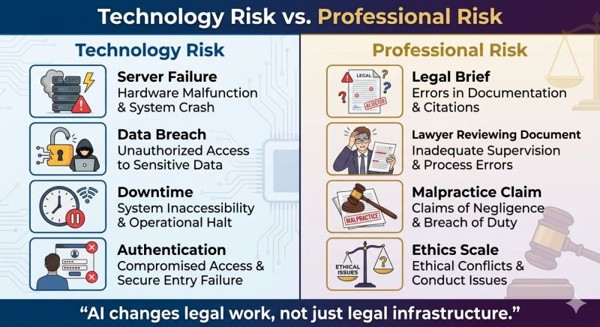
AI doesn’t just create technology risk for law firms.
It creates professional liability risk.
And that’s why insurers are starting to ask different questions about AI use.
Much of the early conversation around AI in law firms focuses on technical concerns: system security, vendor integrations, and infrastructure reliability. These are important issues, but they are not the risks most likely to appear in a malpractice inquiry.
The questions that emerge after an AI-related error are different: who approved the use of the technology, how attorneys were trained to evaluate its output, and what supervision standards applied to AI-assisted work. AI does not just introduce technology risk. It introduces professional risk.
Questions to Consider
- Are we focusing too heavily on technical controls while overlooking professional responsibility risks?
- How is AI changing our supervisory obligations?
- What evidence would demonstrate reasonable oversight?
- Are attorneys trained to verify AI-assisted work?
- Would our governance program withstand scrutiny after an adverse event?
Next Steps for Law Firms
1. Reassess AI Through a Professional Responsibility Lens
Move beyond cybersecurity and technology concerns to evaluate how AI affects legal judgment, supervision, and client service.
2. Define Acceptable AI Use Cases
Establish clear expectations for when and how AI may be used in legal workflows.
3. Formalize Verification Requirements
Require documented review and validation of AI-assisted research, drafting, and analysis.
4. Strengthen Attorney Training
Ensure lawyers understand the limitations, risks, and verification requirements associated with AI-generated content.
5. Clarify Supervisory Expectations
Define partner and supervisory responsibilities for AI-assisted work.
6. Improve Documentation Practices
Maintain evidence of training, governance decisions, policy implementation, and oversight activities.
7. Prepare for Underwriting Questions
Anticipate more detailed inquiries regarding governance, supervision, and verification controls.
Next Steps for Professional Liability Carriers
1. Expand Beyond Technology Questions
Move beyond asking whether AI is used and evaluate how AI-assisted work is governed.
2. Assess Professional Responsibility Controls
Review supervision practices, attorney training, and verification requirements.
3. Evaluate Governance Maturity
Determine whether firms have established accountability structures for AI oversight.
4. Review Documentation Standards
Assess whether governance activities are documented and consistently maintained.
5. Examine Reliance Controls
Understand how firms prevent AI-generated content from reaching clients without appropriate review.
6. Differentiate Risk Based on Governance
Incorporate governance quality into underwriting evaluations and pricing considerations.
Related Topics
- Professional Liability and Artificial Intelligence
- AI Governance Frameworks
- AI Verification Controls
- Human Oversight of AI
- Defensible AI Governance
- AI Risk Management
- Law Firm AI Governance
- Board Oversight of AI
- Attorney Supervision and AI
- AI Governance Maturity Models
- Professional Responsibility and AI
- AI Exposure Formation
- AI Claim Prevention
- Verification Governance
- Enterprise Risk Management