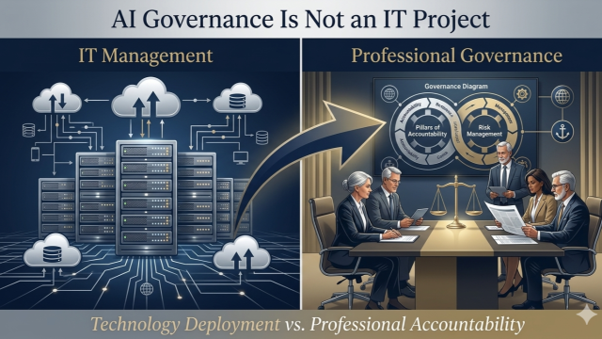
Most law firms are putting AI governance in the wrong department.
AI oversight is often treated as an IT responsibility.
But the real risks sit with leadership, supervision, and professional accountability.
Artificial intelligence is often introduced into law firms through the same pathway as other technologies: vendor demonstrations, pilot programs, and IT implementation. That makes it easy to treat AI as simply another software deployment. But the real risks surrounding AI rarely originate from the technology itself. They arise from how AI influences professional judgment, legal analysis, and the advice delivered to clients.
When AI affects the substance of legal work, governance must move beyond technology management and into leadership oversight. Decisions about supervision, verification, and acceptable use are not IT issues, they are professional responsibility issues that belong at the executive level.
Questions to Consider
- Who currently owns AI governance?
- Does that group have authority over attorney conduct and supervision?
- Are governance decisions being treated as technology decisions?
- Could leadership explain how AI-related risks are managed?
- Does accountability reside where the risk ultimately resides?
Next Steps for Law Firms
1. Identify Current Governance Ownership
Determine whether AI governance currently resides primarily within IT, innovation, knowledge management, or leadership functions.
2. Clarify Executive Accountability
Assign formal ownership of AI governance to executive leadership while leveraging support from technical and operational teams.
3. Separate Technology Management From Governance
Differentiate responsibilities for infrastructure management from responsibilities for supervision, verification, and professional oversight.
4. Review Professional Responsibility Impacts
Evaluate where AI affects legal judgment, client communications, research, drafting, and decision-making.
5. Establish Cross-Functional Governance
Create governance structures that include leadership, risk management, IT, professional responsibility, security, and practice group representation.
6. Increase Leadership Visibility
Ensure executive committees receive regular reporting on AI adoption, risks, incidents, and governance effectiveness.
7. Document Governance Decisions
Maintain records demonstrating oversight, accountability, policy decisions, and governance reviews.
Next Steps for Executive Leadership
1. Treat AI as an Enterprise Risk Issue
Position AI governance alongside conflicts management, ethics oversight, cybersecurity, and quality control.
2. Establish a Governance Committee
Create a formal structure capable of evaluating AI-related risks and governance decisions.
3. Define Verification Expectations
Establish mandatory review and validation requirements for AI-assisted work.
4. Require Governance Metrics
Monitor adoption levels, incidents, escalations, policy exceptions, and training completion.
5. Conduct Periodic Governance Reviews
Review governance effectiveness as technologies and workflows evolve.
Next Steps for Professional Liability Carriers
1. Evaluate Governance Ownership
Assess whether AI governance is treated as a leadership function or delegated entirely to technical teams.
2. Review Accountability Structures
Understand who ultimately owns AI-related risk decisions.
3. Examine Supervisory Controls
Assess how firms oversee AI-assisted work and professional judgment.
4. Evaluate Governance Documentation
Determine whether oversight activities are documented and consistently maintained.
5. Incorporate Leadership Engagement Into Underwriting
Executive involvement may serve as a leading indicator of governance maturity.
Related Topics
- Board Oversight of Artificial Intelligence
- Executive Accountability for AI
- AI Governance Frameworks
- Law Firm AI Governance
- AI Governance Committees
- Professional Responsibility and AI
- Enterprise Risk Management
- Human Oversight of AI
- AI Verification Controls
- Technology Governance
- Defensible AI Governance
- AI Policy Development
- Governance Operating Models
- Professional Liability and AI
- AI Governance Maturity Models