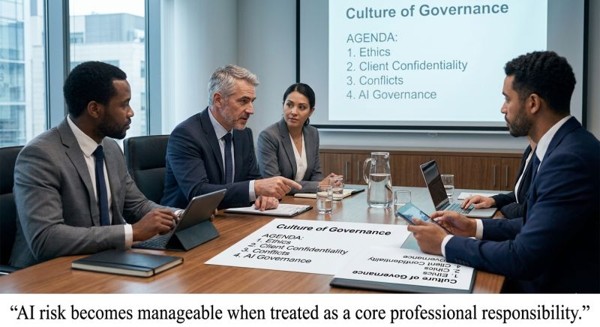
The most effective firms signal this cultural expectation through leadership attention. When AI governance appears alongside conflicts management, ethics compliance, and client confidentiality in leadership discussions, it communicates that AI oversight is not an experimental initiative but a core professional responsibility. Over time, that signal shapes how attorneys approach both innovation and risk.
How is your organization framing AI governance internally, as a technology issue or a professional responsibility? I’m always interested in hearing how different firms are approaching this shift.
Questions to Consider
- What message does leadership send about AI governance today?
- Do attorneys view AI oversight as optional or expected?
- Is AI governance discussed alongside ethics, confidentiality, and conflicts management?
- How does the firm reinforce responsible AI use?
- What behaviors are being rewarded, tolerated, or ignored?
Next Steps for Law Firms
1. Elevate AI Governance Discussions
Include AI governance alongside conflicts management, ethics, cybersecurity, and client confidentiality in leadership meetings.
2. Create Consistent Leadership Messaging
Communicate that AI oversight is a professional responsibility issue rather than merely a technology initiative.
3. Reinforce Governance Expectations
Ensure attorneys understand that innovation and accountability are expected to coexist.
4. Align Policies With Culture
Support governance expectations through training, documentation, supervision, and leadership behavior.
5. Recognize Responsible AI Use
Reward behaviors that demonstrate verification, escalation, and thoughtful professional judgment.
6. Measure Governance Engagement
Track participation in training, governance discussions, policy reviews, and escalation processes.
7. Periodically Reassess Cultural Alignment
Evaluate whether actual attorney behavior reflects stated governance expectations.
Next Steps for Executive Leadership
1. Put AI Governance on the Standing Agenda
Treat AI governance as a recurring governance topic rather than an occasional technology discussion.
2. Demonstrate Visible Engagement
Ask questions about AI risks, controls, incidents, and oversight activities during leadership reviews.
3. Connect AI to Existing Professional Responsibilities
Frame AI governance similarly to conflicts management, ethics compliance, and confidentiality obligations.
4. Establish Governance Expectations Firm-Wide
Communicate that responsible AI use is part of professional competence and diligence.
5. Lead Through Example
Model the balance between innovation, verification, supervision, and accountability.
Next Steps for Professional Liability Carriers
1. Evaluate Leadership Engagement
Assess whether AI governance receives meaningful executive attention.
2. Review Governance Culture Indicators
Look beyond policies to understand how governance expectations are communicated and reinforced.
3. Assess Organizational Alignment
Determine whether governance expectations are understood consistently across practice groups.
4. Consider Leadership Attention as a Risk Indicator
Organizations that actively discuss governance often identify and address emerging risks sooner.
Related Topics
- AI Governance Culture
- Board Oversight of Artificial Intelligence
- Executive Accountability for AI
- Professional Responsibility and AI
- Governance Leadership
- Human Oversight of AI
- Defensible AI Governance
- Enterprise Risk Management
- AI Governance Committees
- AI Policy Development
- Organizational Culture and Risk
- Law Firm Leadership
- Governance Maturity Models
- Ethical AI Use
- AI Risk Management