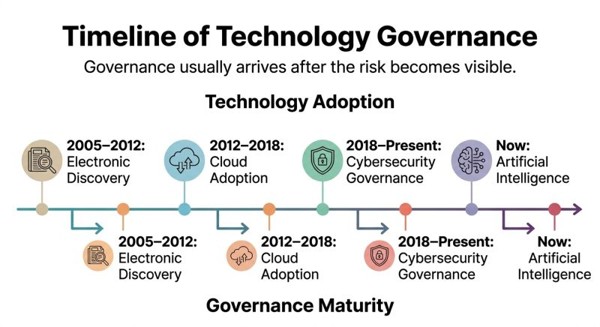
Technology adoption always moves faster than governance.
Law firms have seen this pattern before with eDiscovery and cloud adoption.
AI may be the first time the lag affects the substance of legal advice.
Legal technology has historically followed a familiar pattern. Tools arrive first. Adoption spreads quickly. Governance frameworks emerge only later, often after courts, regulators, or insurers begin asking difficult questions.
Artificial intelligence appears to be following the same trajectory. The difference is that AI touches the analytical core of legal practice, which means the gap between adoption and governance may carry greater professional implications than previous waves of technology.
Where do you think the legal profession currently sits on this curve: early adoption or early governance? I’m curious how others are seeing this evolve.
Questions to Consider
- Is our governance maturity keeping pace with AI adoption?
- Have we repeated governance mistakes seen during earlier technology transitions?
- Which AI use cases currently operate without formal oversight?
- What governance controls should already be in place?
- Are we waiting for external pressure before strengthening governance?
Next Steps for Law Firms
1. Assess the Governance Gap
Compare current AI adoption levels against existing governance capabilities, policies, and oversight structures.
2. Identify Unmanaged AI Use Cases
Determine where attorneys or practice groups may be using AI without formal guidance or supervision.
3. Accelerate Governance Development
Ensure policies, verification standards, training programs, and escalation procedures evolve alongside adoption.
4. Review Lessons From Prior Technology Transitions
Apply governance insights from eDiscovery, cybersecurity, cloud adoption, and information governance programs.
5. Increase Leadership Visibility
Provide executive committees with regular updates on AI adoption trends and associated risks.
6. Establish Governance Review Cycles
Periodically reassess policies and controls as AI capabilities continue to evolve.
Next Steps for Professional Liability Carriers
1. Monitor Governance Maturity
Evaluate whether insured firms are developing governance frameworks at the same pace as adoption.
2. Identify Governance Lag Indicators
Look for signs of widespread usage without corresponding policies, training, or oversight.
3. Expand Underwriting Questions
Focus on governance controls rather than solely on technology deployment.
4. Encourage Early Governance Development
Promote governance practices before claims trends become statistically significant.
5. Monitor Emerging Industry Standards
Track evolving expectations from courts, regulators, bar associations, and clients.
Related Topics
- AI Governance Frameworks
- AI Adoption and Risk Management
- Enterprise AI Adoption
- Board Oversight of AI
- AI Governance Maturity Models
- Professional Responsibility and AI
- Law Firm Innovation Governance
- AI Verification Controls
- AI Risk Management
- Defensible AI Governance
- Professional Liability and AI
- Technology Governance
- Organizational Change Management
- AI Policy Development
- Governance Lag Risk