AI doesn’t fail all at once—it creeps in.
Structured checkpoints stop risk before it compounds.
Firms with weak escalation paths face defensibility questions.
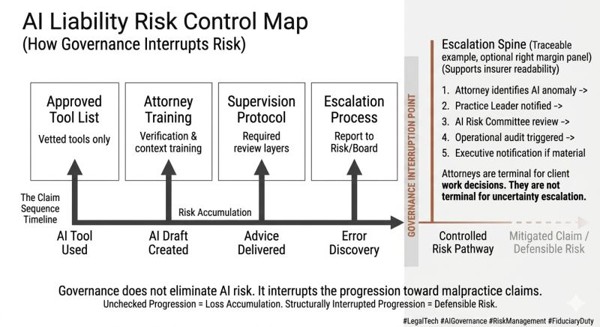
AI risk in legal practice rarely appears all at once. It accumulates across a sequence of small steps: a tool is used, a draft is created, advice is delivered, and only later is an error discovered. Without governance controls in place, that progression can quietly transform operational convenience into liability exposure. The purpose of AI governance is not to eliminate risk entirely, but to interrupt the pathway where unmanaged risk turns into a malpractice claim.
The control points illustrated here show how firms can insert practical governance into the workflow. Approved tool lists, attorney training, supervisory review, and clear escalation pathways create structured moments where risk can be identified and managed before it compounds. When these mechanisms are present, organizations shift from uncontrolled exposure to defensible risk management.
If your firm or organization is evaluating how AI fits within existing risk, compliance, or professional responsibility frameworks, I’m always open to conversations about practical governance structures and implementation approaches.
Questions to Consider
- Where are governance controls embedded in our workflows?
- What events trigger escalation?
- Are attorneys trained to recognize situations requiring review?
- How quickly can leadership become aware of emerging risks?
- Which control failures would create the greatest liability exposure?
Next Steps for Law Firms
1. Identify Existing Control Points
Map where AI-generated content enters legal workflows and where review currently occurs.
2. Define Required Verification Checkpoints
Establish mandatory validation steps before AI-assisted work can advance to client-facing stages.
3. Create Escalation Triggers
Define circumstances requiring supervisory review, governance review, or risk management involvement.
4. Standardize Review Procedures
Ensure attorneys and supervisors follow consistent verification expectations.
5. Test Workflow Controls
Conduct scenario exercises to determine whether errors would be detected before client delivery.
6. Measure Control Effectiveness
Track incidents, near misses, escalations, and recurring verification failures.
7. Refine Controls Based on Experience
Continuously improve governance checkpoints as AI capabilities and workflows evolve.
Next Steps for Professional Liability Carriers
1. Assess Control Point Coverage
Determine whether firms have defined verification and escalation checkpoints.
2. Evaluate Reliance Controls
Review how firms prevent AI-assisted work from bypassing human oversight.
3. Examine Escalation Procedures
Assess whether unusual AI behavior triggers structured review.
4. Review Governance Documentation
Determine whether firms can demonstrate consistent application of controls.
5. Differentiate Firms by Control Maturity
Incorporate workflow controls into underwriting evaluations.
6. Encourage Preventative Governance
Reward firms that demonstrate documented verification and escalation practices.
Related Topics
- AI Verification Frameworks
- Verification Governance
- AI Escalation Procedures
- Human Oversight of AI
- AI Governance Controls
- AI Exposure Formation
- AI Error Prevention
- Professional Liability Risk Management
- AI Incident Management
- Defensible AI Governance
- Workflow-Based Risk Management
- AI Quality Assurance
- Law Firm AI Governance
- AI Governance Maturity
- Supervisory Responsibilities in AI Usage